Slowed Reverb History & Culture: From DJ Screw to TikTok
Data engineer who loves building high-performance data and web-related tools. Creator of SlowedReverbMaker.net, implementing browser-side digital signal processing (DSP) to democratize audio editing.
1. DJ Screw and the Roots of Slowed Music
In Houston's South Park neighborhood, Robert Earl Davis Jr. — better known as DJ Screw — built a sound that would ripple across decades. Born in July 1971, he began DJing at 12, in 1983, and by the early '90s had developed something new: he ran two copies of the same record at once, slowed them down, and cut between them with the crossfader to repeat words and stretch phrases. The result was heavy, hypnotic, and completely new.
From the early 1990s until his death in 2000, Screw released over 350 'Screw Tapes' — mixes he sold for $10, first out of his own home and later from his store, Screwed Up Records and Tapes on Cullen Boulevard. He was reportedly moving thousands of tapes at his peak, cash-only, no labels involved. That grassroots hustle laid the blueprint for today's entire creator economy.
Try this while you read: Chopped & Screwed Maker
Screw a song down and chop it on the beat. Free, in your browser, no signup.
2. How the Technique Actually Works
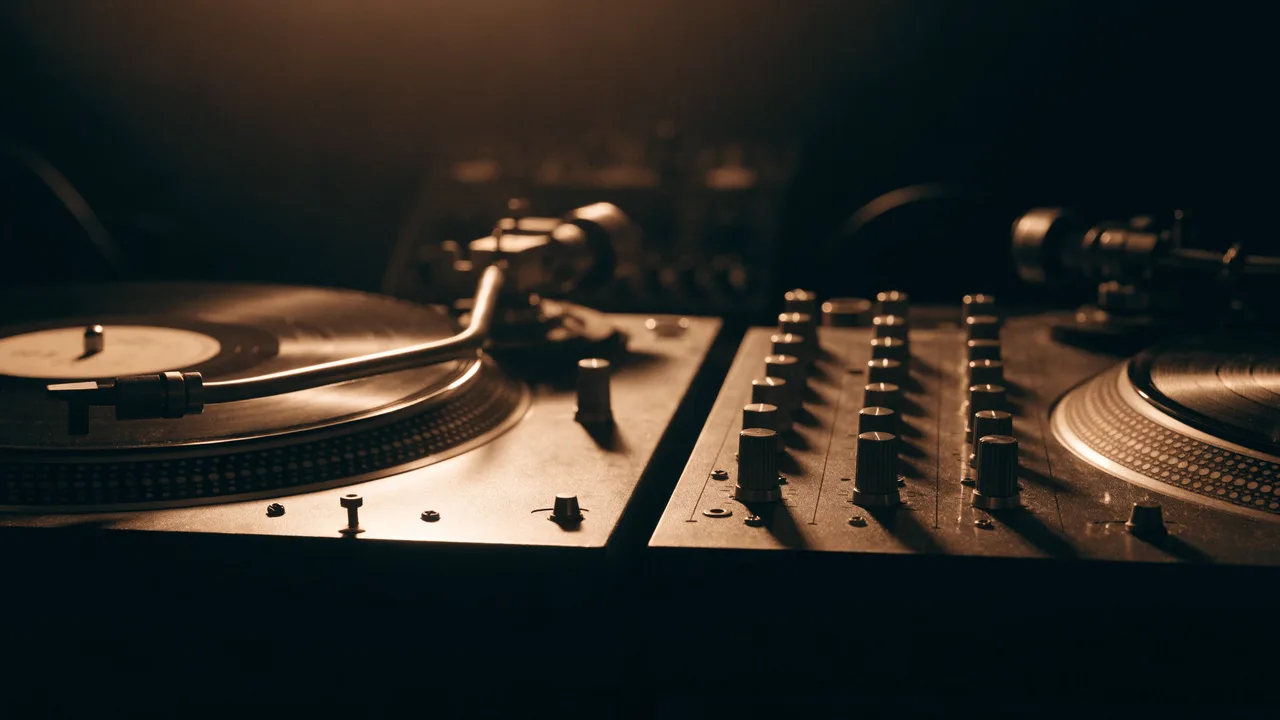
On vinyl, pitch and speed are physically the same thing. Slow the platter from 33⅓ RPM to about 27-30 RPM and the pitch drops by roughly 1.8 to 3.7 semitones automatically. Worth noting that a stock Technics pitch fader only spans ±8%, which is about 1.4 semitones — so the deeper slowdowns associated with screw tapes needed more than the fader alone. You can do it in 30 seconds today on SlowedReverbMaker.net — same coupled resampling, same physics, just without the needle drops.
- Speed reduction of 10-25% → pitch drops about 1.8-5.0 semitones (same on vinyl and digital).
- SlowedReverbMaker.net uses the exact same coupled-resampling principle DJ Screw pioneered.
- Chopping is a separate operation from screwing: screwing is continuous slowing, chopping is cutting and repeating individual beats. The chopped and screwed maker does both, estimating the track's tempo from the audio so repeats land on the beat rather than on a fixed clock.
2a. What the Screw Tapes Were Actually Doing
It is worth separating the two halves of the name, because most tools that rank for the term only do one of them and most listeners assume they are the same thing.
Screwing is the continuous slowdown — the platter running below 33⅓, everything lower and heavier. This is the part that transfers cleanly to a browser, because it is a single global operation.
Chopping is rhythmic surgery. Two copies of the same record on two turntables, the crossfader cutting between them to repeat a word, stutter a bar, or skip forward. It is a performance, done in real time, and it is why screw tapes sound like a person is present rather than like a filter was applied.
The distinction matters historically because the chopping is the part that made it a technique rather than an effect. Anyone could slow a record down. Screw's tapes are recognisable because of what he did with the second turntable — and it is also the part that requires a musical decision on every cut, which is why automating it convincingly means detecting the tempo first rather than chopping on a timer.
3. Slowed Reverb vs Chopped and Screwed
Chopped and screwed is a Houston hip-hop DJ technique built around slowing records, repeating phrases, scratching, and manually chopping sections. Slowed reverb is a newer internet editing style that applies continuous speed reduction plus digital reverb without turntable-style stutters.
- Origin: chopped and screwed comes from the Houston hip-hop scene; slowed reverb grew through YouTube, TikTok, and bedroom editing communities.
- Tempo: chopped and screwed often pushes tracks to 60-75 BPM; slowed reverb lands around 75-95 BPM.
- Structure: chopped and screwed repeats words and phrases; slowed reverb keeps the original structure intact.
- Tools: chopped and screwed was built on turntables; slowed reverb works in a browser with speed, pitch, bass, and reverb controls.
4. Why Slowed Music Triggers an Emotional Response
It is worth being careful here, because this is a topic where confident-sounding neuroscience gets invented and repeated. There is no study we can point to showing that a particular BPM range switches on a particular brain network, or that lowering a track by a few semitones measurably increases reward-centre activity. If you see those claims attributed to a named journal or lab, treat them with suspicion — we published versions of them on this page ourselves until we went back and checked.
What is genuinely established is broader and more interesting. Music is an unusually strong trigger for autobiographical memory: studies have found music-evoked memories to be more vivid than those prompted by famous faces, and more frequent and personally important than those prompted by other everyday cues. Music-evoked nostalgia has been characterised as a genuinely mixed emotion, involving joy and sadness at once rather than one shaded by the other. And low-frequency sound vibration has been studied for relaxation effects, though the work is mostly small pilot studies reporting modest changes in heart-rate variability rather than anything as tidy as your pulse syncing to the bassline.
So slowing a song down does something real to how you receive it — but the honest version is that the mechanism is under-studied, not that it has been pinned down. We go into what the research does and does not support in why muffled edits feel so emotional.
- Music is a stronger autobiographical memory cue than most everyday triggers.
- Music-evoked nostalgia is a mixed emotion — joy and sadness together, not one or the other.
- Low-frequency vibration research exists but is early: small pilots, modest heart-rate-variability effects.
- Reverb adds spatial depth that simulates acoustic space, creating a sense of distance and intimacy.
5. From Meme to Industry
Slowed and sped-up edits moved from bedroom uploads to something the majors had to have a position on. We are deliberately not quoting hashtag view totals here — TikTok stopped publishing them on public tag pages, so any figure you see is unverifiable by the person reading it.
What is on the record is more useful anyway. In June 2023, Universal Music Group released 'Sped Up Songs: Official Remixes from Viral Creators and Speed Radio,' a compilation of officially sanctioned sped-up versions made with an existing creator collective. That is the industry conceding the format has commercial value. The same period saw UMG issuing mass takedowns on TikTok aimed largely at modified uploads — sped up, slowed down, pitched up or down — which is the same industry drawing a line around who gets to make them. Both things are true at once, and if you post edits it is worth understanding that tension.
6. What Reverb Added, and What the Browser Changed
Slowed reverb is not simply screw music with a new name, and the difference is in the second word. Screw's setup could slow and chop, but it could not add a room — reverb was something that happened during recording or in a studio, not something a DJ applied to a finished record on two turntables.
That addition changes the effect substantially. Slowing alone makes a track heavier and lower. Reverb makes it distant, and distance is what produces the specific quality the modern style is chasing: music that sounds like it is happening somewhere you are not. The internet style inherited Screw's technique and added the one thing his equipment could not do.
The reason it can now be done in a browser is that the Web Audio API provides the same primitives a DAW plugin works with — convolution, biquad filters, sample-accurate scheduling, and 32-bit float precision throughout the graph. A convolution is not a lesser convolution for running in JavaScript. Given the same impulse response and input, a browser and a DAW compute the same operation, with differences confined to floating-point rounding and how each implementation partitions the work.
What that does not mean is that browsers exceed DAWs. DAWs also process in 32- or 64-bit float, and the float precision protects intermediate values in the graph rather than improving the finished file — export to 16-bit and you are back to roughly 96 dB of dynamic range like everything else. The honest claim is narrower and still significant: for this particular job, the platform is no longer the limiting factor. Your source file and your settings are.
The engineering detail is here if you want the graph, the algorithms, and an account of a real bug in this engine that measurement caught and listening did not.
7. The Legacy Lives On
Screw died in November 2000, at 29. The scene he built did not stop — the Screwed Up Click carried it, Houston kept making it, and by the 2010s the sound had been absorbed into hip-hop broadly enough that plenty of people using it had no idea where it came from.
June 27 has become an unofficial Houston holiday, after the 1996 tape recorded that day — it was made for the birthday of Big DeMo, a rapper in Screw's circle, and the long freestyle it carries over a Kris Kross instrumental became the best-known thing he ever released. Not a single, not an album. A birthday tape.
His records are held in the Houston Hip Hop Research Collection at University of Houston Libraries Special Collections, including roughly 1,500 of his own vinyl records alongside recordings, photographs, and handwritten track lists. A DJ who sold cash-only cassettes out of a house on Cullen Boulevard is now an archival subject with a university exhibit built around his crates.
The through-line to a browser slider is shorter than it looks. Both are coupled pitch-and-speed reduction — identical physics, different hardware. What changed is who has access: a technique that required two turntables, two copies of a record, and years of practice is now a control anyone can move. Whether that is preservation or dilution is a fair argument, and worth having honestly rather than settling with a slogan. Every time someone drags a speed slider down they are using Screw's idea; whether they are continuing his tradition is a different question, and the answer probably depends on whether they know whose idea it was.
Sources and Corrections
Biography, the June 27 tape, and the archive: University of Houston Libraries Special Collections — the Houston Hip Hop Research Collection and the online exhibits built around DJ Screw's record collection, which document the roughly 1,500 vinyl records held there and the circumstances of the June 27, 1996 recording (made for Big DeMo's birthday).
Industry material: Universal Music Group's June 2023 release of an officially sanctioned sped-up compilation, and the same period's mass takedowns on TikTok aimed at modified uploads.
The pitch arithmetic is computed rather than cited: 12 × log₂(rate) semitones, which gives roughly −1.8 to −3.7 semitones for a platter slowed from 33⅓ to 30 or 27 RPM, and about −1.4 semitones for the ±8% range of a standard Technics pitch fader.
Two corrections to earlier versions of this page. It described modern tools as automating chopping with WSOLA — that is wrong; WSOLA is a time-stretching algorithm and has nothing to do with rhythmic chopping, which requires tempo detection. It also compared browser tools against DAWs using invented figures for cost, learning time, and processing speed, and claimed browser processing 'exceeds most DAW engines'. That claim was false and the figures were unsourced; both have been removed rather than adjusted. Claims about specific BPM ranges activating specific brain networks were removed in an earlier pass for the same reason.